



A ride that costs $70 before you’ve even left the airport. A boat tour that never stops at the Statue of Liberty. A pedicab trip that lasts 15 minutes and ends with a $120 bill.
Not exactly the New York memories anyone wants to bring home.
Some tourist traps are easy to recognize. Others involve people who look official, familiar attractions with confusing ticket options, or prices that aren’t explained until it’s time to pay.
And this isn’t just something travelers complain about online.
In June 2026, the New York City Council published an investigation into deceptive practices involving ferry-ticket sellers, pedicab drivers and unauthorized transportation services. Investigators documented misleading sales pitches, hidden charges and operators presenting themselves as properly licensed when they weren’t.
The distinction matters. New York has plenty of expensive experiences that are worth paying for. A pricey sightseeing cruise isn’t automatically a scam, and neither is a street performer asking for a tip.
The problem starts when the experience you’re paying for isn’t the one you were promised.
Here are ten situations worth knowing about, including a few that catch New Yorkers off guard, too.
Some links in this guide are affiliate links. We may earn a commission if you make a purchase, at no additional cost to you.
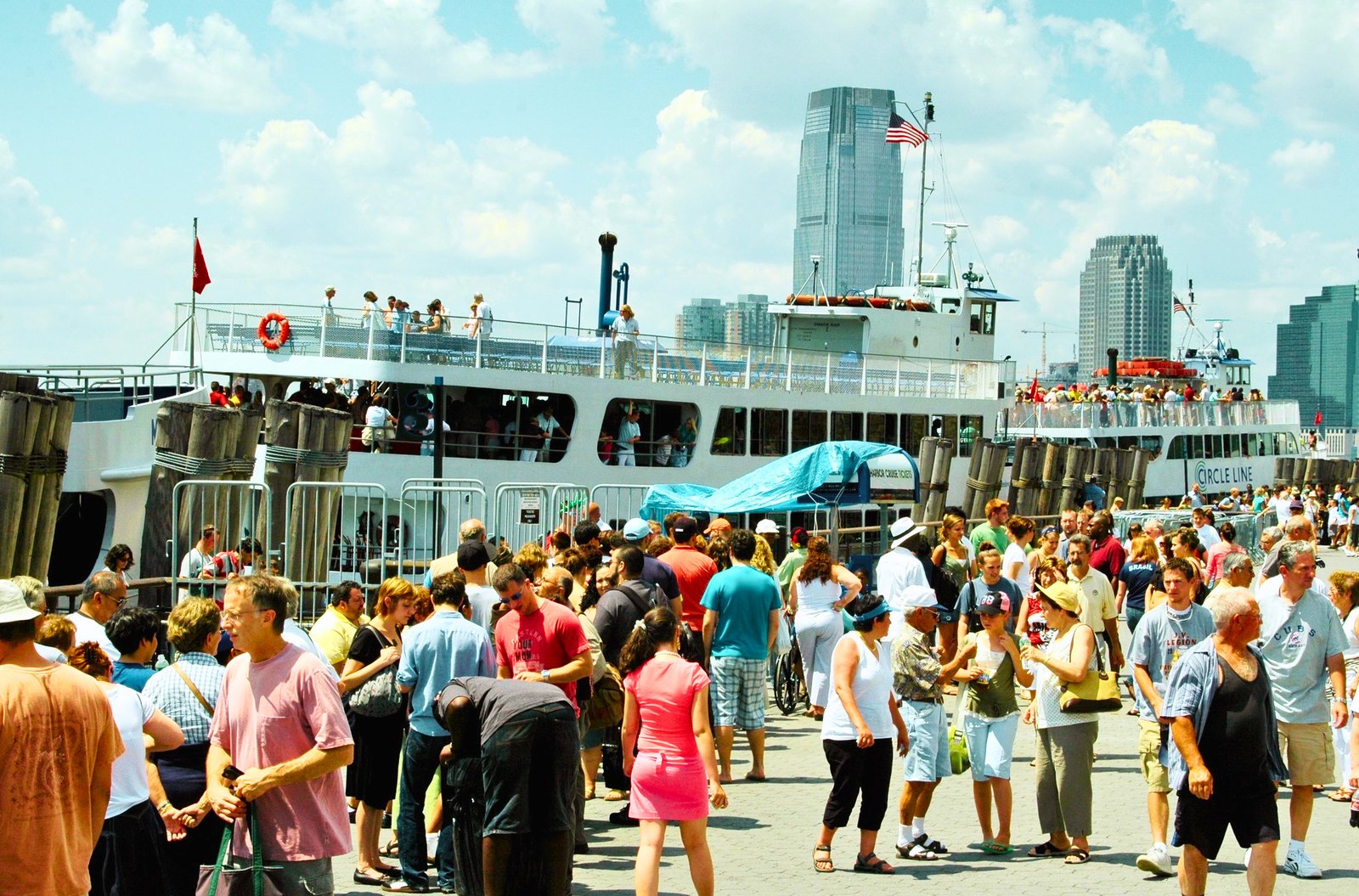
 Statue of Liberty Ticket Scams Around Battery Park
The southern end of Manhattan is a confusing place to buy a boat ticket if you haven’t done your research.
Around The Battery, you’ll encounter signs for harbor cruises, sightseeing boats and Statue of Liberty tours. Some are legitimate businesses offering exactly what they advertise. Others use sales pitches that make it difficult to tell what you’re actually purchasing.
The difference can be substantial.
You might think you’re buying a ticket that lets you walk around Liberty Island, visit the museum and continue to Ellis Island. Instead, you end up on a boat that sails past the statue and returns to Manhattan.
A sightseeing cruise isn’t a bad experience. It’s just not the same as visiting the islands.
New York City Council investigators documented this exact problem in 2026. Some sellers gave tourists the impression that their boats would stop at Liberty Island when they only circled it. Others failed to disclose additional transportation costs to reach their departure piers. Press
How to visit the Statue of Liberty without getting the wrong ticket
The National Park Service authorizes only one ferry operator to transport visitors to Liberty Island and Ellis Island: Statue City Cruises.
Tickets can be purchased at statuecitycruises.com or through its official ticket windows inside Castle Clinton, the circular stone fort in The Battery.
The official ferry also departs from Liberty State Park in New Jersey.
Your ferry ticket includes transportation to the islands and admission to their museums. Access to the statue’s pedestal or crown requires the appropriate reservation, and those tickets can sell out well in advance.
There’s also an important change for 2026 visitors.
A new security screening and boarding facility opened at The Battery on March 6, 2026. The time on your reserved ticket indicates approximately when you should join the security screening line, not the exact time your ferry leaves. Visitors are instructed not to arrive more than 30 minutes before their reservation time. National Park Service
That is worth knowing before someone on the street tries to convince you that you’ve missed your boat.
If you’re buying a ticket in person, go directly to Castle Clinton. If you’ve already booked, follow the instructions from Statue City Cruises rather than taking advice from someone offering to change your reservation.
And before purchasing any other harbor tour, ask whether the boat actually docks at Liberty Island.
An honest sightseeing operator should have no trouble answering that question.
 Paying for the Staten Island Ferry When It’s Completely Free
There’s a good reason the Staten Island Ferry appears in so many New York travel recommendations.
It crosses New York Harbor, offers views of the Statue of Liberty and the Lower Manhattan skyline, and doesn’t cost a cent.
The Staten Island Ferry is free for everyone.
No reservation, admission ticket or sightseeing pass is required.
Yet visitors continue to report being approached by people selling tickets or alternative tours around Lower Manhattan.
In July 2026, a rideshare driver described how people near the ferry area tried to approach passengers he was dropping off. His passengers had specifically requested the free ferry, and he said he’d warned them about ticket sellers before they arrived. It’s one person’s account, but it illustrates a confusion the city’s consumer protection guidance explicitly warns about.
Where to board the real Staten Island Ferry
In Manhattan, go to Whitehall Terminal at 1 Whitehall Street, near South Ferry subway station.
The orange ferries travel to St. George Terminal on Staten Island. Each crossing takes approximately 25 minutes, and the service operates year-round.
You’ll need to get off at St. George and board a departing ferry to return to Manhattan.
The ride gives you a view of the Statue of Liberty from the water, but it does not stop at Liberty Island or Ellis Island.
That’s the key distinction.
If you want to see the statue from a distance without paying for a harbor cruise, the Staten Island Ferry is a good choice.
If you want to step onto Liberty Island, visit the museum or explore Ellis Island, you’ll need a Statue City Cruises ticket.
Both are worthwhile experiences. Just don’t let anyone sell you the free one.
Check the official Staten Island Ferry schedule before heading down, particularly if you’re traveling late at night or on a holiday.
 Unlicensed Airport Taxis and Unexpected JFK Fares
After an overnight flight, even experienced travelers can be tempted by the promise of a quicker ride to their hotel.
Someone near the arrivals area offers a car. They say the official taxi line will take too long, or that their price is better than Uber.
You haven’t even reached the taxi stand, and someone’s already trying to sell you transportation.
It’s a familiar problem at busy airports.
Be careful when arriving at JFK, as unauthorized drivers may approach travelers even near the official taxi lines. Some use misleading signs or claim to offer legitimate transportation services. For your safety, always use the official taxi dispatch area or book through a licensed transportation provider.
How much should a taxi from JFK to Manhattan cost?
NYC yellow taxis have a regulated $70 base flat fare between JFK Airport and Manhattan, in either direction.
The final charge is higher once applicable surcharges, airport pickup fees, tolls and tips are included.
For example, JFK pickups carry a $2 airport access fee, and a $5 rush-hour surcharge applies to JFK-Manhattan trips on weekdays from 4 PM to 8 PM, excluding legal holidays.
The flat fare does not apply to every destination in New York City.
A yellow taxi from JFK to Brooklyn or Queens, for example, generally uses the standard metered rate.
LaGuardia also works differently: yellow taxis charge a metered fare, plus the applicable airport surcharge and other charges.
You can check all the current rates on the NYC Taxi and Limousine Commission website.
How to avoid an airport taxi scam
At JFK or LaGuardia, follow the airport’s official signs to the taxi stand.
If you’re using Uber or Lyft, book through the app and confirm the driver’s name, vehicle and license plate before getting in.
A legitimate rideshare driver shouldn’t need to approach you in the terminal to negotiate a fare.
Taking a yellow taxi from the official stand substantially reduces the risk, though it doesn’t guarantee every driver will behave properly.
Even when using the official JFK taxi stand, it’s important to check your fare. Some passengers have reported being asked to pay extra charges beyond the regulated rate. Always confirm the fare, request a receipt, and report suspicious charges to NYC’s 311 service.
For yellow taxis, keep your receipt and check the fare information shown in the vehicle. On a normal JFK-Manhattan flat-fare journey, the taxi display should indicate Rate 2.
A driver cannot simply invent an extra luggage fee or demand more money because traffic was worse than expected.
And don’t let someone pressure you into paying cash if you planned to use a card. Licensed yellow taxis must accept card payments when their equipment is working. If the card machine isn’t working, the driver must tell you before starting the ride.
 Pedicab Rides That Cost Far More Than Expected
Pedicabs are easy to spot around Times Square and Central Park.
Some have bright lights or music. Others advertise sightseeing routes or offer a way to get around Midtown without walking.
They can be fun, especially when someone in your group is tired of navigating crowded sidewalks.
The problem is that a ride described as “just a few minutes” can become surprisingly expensive.
NYC pedicabs are generally charged by the minute, not by distance.
Consider a driver charging $8 per minute. That’s $80 for ten minutes, or $120 for fifteen.
Those are examples, not official citywide rates. Individual operators set their prices.
The city doesn’t prohibit an expensive rate simply because someone considers it unreasonable. It does, however, regulate how the price must be displayed and calculated.
In its June 2026 investigation, the City Council found pedicab operators concealing mandatory rate signs or telling passengers they charged by time without explaining how much each minute cost. Press
What NYC pedicab drivers are required to do
Licensed pedicab drivers must display their per-minute rate on both exterior sides of the vehicle and behind the bicycle seat.
They must use a city-inspected, sealed timer that passengers can see.
They cannot add taxes, charge extra because more people are riding, or impose a mandatory tip. The displayed price is for the ride, not per passenger.
You’re also entitled to a Pedicab Information Card containing the ride details and information about the operator.
These are city rules, not optional courtesies. Before getting in, look at the rate sign yourself.
Ask approximately how long the trip will take, and do the math.
If a driver quotes $6 per minute for a 20-minute ride, that’s approximately $120. Knowing that before leaving is very different from discovering it after arriving.
For a ride through Central Park, also consider booking a licensed tour in advance if you want a known itinerary and price.
A pedicab is a perfectly legitimate experience when the operator follows the rules and the passenger understands what they’re buying.
 Times Square Characters and the Photo You Didn’t Know You’d Be Tipping For
There are few places where street entertainment is as visible as Times Square.
Costumed superheroes, cartoon characters and other performers regularly approach tourists for photographs.
Most visitors understand that tips are part of the arrangement. The uncomfortable part comes when the expected amount isn’t clear, or when several performers join a photo and each asks for money.
One character may pose with your family. Another steps into the picture. Suddenly you’re being asked to tip two or three people.
The Times Square Alliance acknowledges that performers generally expect tips for photos, but it also makes the rules clear.
You are not legally required to tip a costumed character, even after taking a photograph.
The performers are independent, not officially licensed representatives of the entertainment companies whose characters they portray.
If you want a picture, agree on the expected tip beforehand.
If several characters join in, clarify whether each expects to be paid.
You can also simply decline and walk on.
This isn’t about avoiding everyone in costume. Many performers provide a perfectly pleasant experience, and tipping someone who entertains you is reasonable.
It’s the pressure and lack of clarity that cause problems.
If a performer becomes aggressive, the Times Square Alliance recommends contacting an NYPD officer or a Times Square Safety Officer. You can reach the Times Square Alliance at 212-452-5218.
And remember that it’s possible to photograph Times Square itself without paying anyone. The lights, crowds and enormous billboards are already quite a show.
 Food Cart Overcharging: When the Menu Has No Prices
New York street food is worth exploring.
A good halal platter, breakfast sandwich or pretzel can be one of the more affordable meals you’ll find in Manhattan.
But pay attention when a cart has no visible prices.
In February 2026, a Reddit user on r/FoodNYC described an encounter near the southern entrance to the High Line. According to the post, a tourist was quoted $19.95 for a lamb-over-rice order at a truck whose menu prices appeared to have been erased.
When the person questioned the amount, the vendor reportedly refused to explain it.
That account hasn’t been independently verified, and $19.95 isn’t proof of wrongdoing by itself. What’s notable is the missing price information. Reddit
NYC requires vendors to post prices. Customers also have the right not to be charged more than the advertised amount.
Watch the payment terminal, too
In August 2026, another Reddit user described paying for fries and water at a Financial District food cart. The amount shown at checkout was $8.96, but the user later reported a higher charge appearing on their account.
A separate November 2026 post alleged a much larger discrepancy after a food-truck purchase in Queens.
These are individual reports rather than verified findings against the businesses involved, but they point to a practical precaution: check the amount on the payment device and keep the receipt. Reddit+1
A few things make a difference:
Ask for the total before ordering, especially if no prices are displayed. Check the amount before tapping your card or phone. If the vendor can’t clearly explain the charge, you can choose another cart.
If you’ve been charged more than the posted price, NYC accepts complaints through its street vendor complaint service.
Include the location, date, time and vendor information if you have it.
There’s no reason to treat every street vendor with suspicion. Plenty of excellent carts earn repeat business from locals.
The good ones should have no problem telling you what lunch costs.
 Broadway Tickets From Sellers Who Aren’t Authorized
Broadway tickets can take a big bite out of a travel budget, so a discount naturally gets people’s attention.
Around Times Square, you might hear someone offering tickets to a popular show or claiming to have seats available at a better price than the box office.
Not every resale offer is fraudulent. But buying from someone you don’t know on the street makes it difficult to verify whether the tickets are genuine, valid for the correct performance or priced fairly.
Fortunately, New York has established ways to find legitimate discounts.
Where to find real Broadway ticket deals
The TKTS booth beneath the red steps in Times Square is one of the best-known places to buy discounted theater tickets.
It’s operated by TDF, a nonprofit performing arts organization.
The available shows and final ticket prices are displayed at the booth. Tickets are generally offered for same-day performances, with availability depending on the production.
TDF explicitly warns people not to buy tickets from individuals on the street claiming to represent TKTS. Those sellers are not affiliated with the organization. TDF
You can check TKTS information at tdf.org.
For a specific Broadway show, the safest starting point is its official website, which should direct you to the authorized ticket seller.
The theater’s own box office is another option.
Established services such as TodayTix may also offer legitimate discounted tickets, although fees, restrictions and available performances can vary.
Before paying a private seller, consider what happens if the ticket won’t scan at the theater door.
That’s a difficult problem to solve five minutes before the curtain goes up.
 The “Free” CD or Bracelet That Comes With a Payment Demand
This is a smaller street hustle, but it’s worth recognizing.
Someone approaches you with a CD, bracelet or small souvenir. They describe it as a gift or ask you to support their work.
The conversation seems harmless until you’ve accepted the item.
Then the request for money begins.
Sometimes it’s a suggested donation. Other times the person becomes persistent, argues about the amount or tries to make you feel uncomfortable about refusing.
These interactions have been reported around busy visitor areas such as Times Square and Rockefeller Center.
In December 2025, a group member described being approached near the Rockefeller Center Christmas tree by someone offering a supposedly free CD. When the user declined, the person allegedly tried to provoke a reaction by making an accusatory remark.
There isn’t anything wrong with musicians selling their work or asking for support.
The warning sign is when something presented as free becomes an unwanted financial obligation.
If you aren’t interested, decline before accepting the item.
If you already have something in your hand, return it rather than negotiating over an unexpected price.
And if the encounter turns confrontational, move toward a populated area instead of continuing the argument.
For people visiting New York for the first time, it’s useful to know that declining a street sales pitch isn’t rude.
You can be friendly without agreeing to buy something.
 Fake Parking QR Codes – A Scam That Affects New Yorkers Too
Not all scams happen beside tourist attractions.
Some target people doing something as ordinary as paying for parking.
In September 2026, the Manhattan District Attorney announced an indictment involving fraudulent QR code stickers placed on parking meters.
Investigators found 64 stickers on Manhattan parking meters directing drivers to a fake website that imitated the city’s ParkNYC payment service.
The site requested financial information, including credit card details.
The criminal allegations were not, by themselves, a conviction. But the city’s warning about the payment method is unequivocal. Manhattan District Attorney’s Office
Never use a random QR code to pay for NYC street parking
New York’s Department of Transportation says motorists should not scan QR code stickers attached to parking meters to make payments.
Instead, use the physical parking meter or an official ParkNYC payment method that you’ve accessed independently.
If you’re using the app, get it through the legitimate app store rather than following a link from a sticker.
NYC also warns drivers about fake text messages claiming to be from CityPay and demanding payment for parking violations.
The city’s Department of Finance says it does not send unsolicited text reminders directing people to pay through those links. DOF
If you’ve scanned a suspicious code but haven’t entered any information, close the page.
If you’ve already provided payment details, contact your card issuer promptly.
You can report suspicious parking-meter QR stickers to ParkNYC at 800-428-4027 or parknyc@flowbirdapp.com.
This is one of those situations in which living in New York doesn’t necessarily give someone an advantage. A fake sticker on an otherwise legitimate machine can look convincing to almost anyone.
 Hotel Fees That Appear After You’ve Booked
A hotel room advertised for $220 a night may look reasonable compared with other options in Midtown.
Then you reach the final booking stage or check-in counter and discover a destination fee, hospitality charge or mandatory amenity fee.
For a four-night stay, even a $35 daily charge adds another $140.
That’s enough to change which hotel you would have chosen.
Hotels have used various names for these charges for years. Some guests don’t realize they’re mandatory until well into the booking process.
New York introduced stronger rules to address the problem.
What NYC’s 2026 hotel fee rules mean for guests
Beginning February 21, 2026, New York City’s hotel pricing rules require businesses to clearly disclose the total price of a stay, including mandatory charges.
The total price must be more prominent than other advertised pricing details.
Hotels must also provide a clear breakdown of fees and optional services before the guest agrees to pay.
These requirements also apply to third-party travel booking websites covered by the rules.
An expensive hotel isn’t necessarily doing anything wrong.
And a clearly disclosed mandatory fee isn’t automatically unlawful.
The problem is a mandatory charge that wasn’t properly disclosed when you made the reservation.
Before booking, look at the total stay price, not just the nightly rate. Save the confirmation showing the price and terms you accepted.
If the hotel tries to add an undisclosed mandatory fee at check-in, ask where that charge appeared in the original booking.
You can also report suspected violations through NYC’s consumer protection system.
The same advice is useful whether you’re traveling to New York or already live there and are booking a weekend stay.
 What to Do If You’ve Already Been Scammed in NYC
Being overcharged or misled doesn’t always mean the money is gone for good.
Your options depend on what happened, how you paid and whether the business can be identified.
Start by keeping the evidence.
For a taxi, that could mean the receipt, medallion number, pickup location and time of the trip.
For a pedicab, a photograph of the displayed rate and the vehicle’s registration number may help.
For a street vendor, the cart’s location, advertised price and payment receipt are useful.
If you paid by credit or debit card and the amount is incorrect, contact the card issuer promptly. Explain whether the charge was unauthorized or whether you were charged more than agreed.
Where to report NYC tourist scams
Taxi or car-service problems: Report the issue to NYC’s Taxi and Limousine Commission through 311.
Pedicab overcharging: File a complaint with NYC’s Department of Consumer and Worker Protection. The pedicab’s information card should contain identifying details.
Street vendor overcharging: Use the NYC311 Street Vendor Complaint service.
Misleading ticket sales or undisclosed hotel fees: Contact NYC’s Department of Consumer and Worker Protection through 311.
Fake parking QR codes: Notify ParkNYC, your bank if you entered payment information, and law enforcement.
Theft, threats or immediate danger: Contact the police. Call 911 in an emergency.
For general complaints, use NYC311. Within New York City, dial 311. From outside the city, call 212-639-9675.
Reporting an incident doesn’t guarantee a refund. But it creates a record, and that information can help investigators identify businesses or individuals responsible for repeated violations.
If someone becomes threatening, don’t remain in a confrontation just to recover your money.
 A Tourist Trap Isn’t Always a Scam
It’s easy to lump every expensive experience in New York into the same category.
But there’s a difference between paying too much and being deliberately misled.
A sightseeing cruise that costs $50 and clearly explains its itinerary may be exactly what someone wants.
A pedicab driver charging $8 a minute may be expensive, but the rate alone isn’t proof of a scam.
A costumed performer who politely asks for a tip is doing something different from someone who aggressively demands payment.
And a restaurant charging $18 for a sandwich isn’t automatically breaking the law.
What matters is whether you understood the price and the service before agreeing to pay, and whether the business followed the applicable rules.
That’s also why reading the actual details is more useful than relying on viral posts that describe every street seller or tourist attraction as a scam.
New York has thousands of legitimate independent businesses, street performers, guides and drivers. Many provide experiences visitors genuinely enjoy.
It’s the operators who conceal prices, misrepresent their services or pressure people into unwanted purchases that deserve scrutiny.
❓Frequently Asked Questions
Is the Staten Island Ferry free?
Yes. It operates between Whitehall Terminal in Manhattan and St. George Terminal on Staten Island. No ticket is required, and the crossing takes approximately 25 minutes. It does not stop at Liberty Island.
Where can I buy official Statue of Liberty tickets?
Directly from Statue City Cruises online or at its authorized ticket windows. It’s the only ferry operator authorized by the National Park Service to take visitors to Liberty Island and Ellis Island.
How much is a taxi from JFK to Manhattan?
The regulated yellow taxi base flat fare is $70, with applicable surcharges, airport fees, tolls and tips added.
Do I have to tip Times Square characters?
No. Tips are voluntary, although performers may expect them after posing for photos.
Are NYC pedicabs charged per person?
No. Licensed pedicab rates are calculated per minute per ride. Operators cannot add extra passenger fees, taxes or mandatory tips.
Can I report a food cart for not displaying prices?
Yes. NYC accepts complaints about vendors with missing or inaccurate prices, as well as charges exceeding advertised amounts.
Final Thoughts?
There’s no reason to approach every conversation in New York with suspicion.
Most visitors will never encounter anything more troublesome than a long line, an expensive lunch or a subway train heading in the wrong direction.
But knowing the official ferry operator, the regulated JFK taxi fare and the rules around pedicab pricing can save both time and money.
You don’t need to memorize every possible scam.
You just need enough information to recognize when something doesn’t match what you were promised.
And if you’ve experienced a misleading tour, an unexpected charge or a street hustle that other visitors should know about, share what happened with the New York City Tourist Tips & Tricks community.
A specific, well-documented experience is often more useful to another traveler than a dozen general warnings.
❤️ Support Our NYC Travel Guides
We run this site to help travelers move around New York with less stress and better local tips — from subway routes to neighborhood guides and real-life advice. If our guides save you time or help you plan a smoother trip, you can support our work through Patreon. Your support helps us keep guides updated and share honest NYC travel tips without cluttering the site with ads.
Support us on Patreon


0 Comments